

What do I have to do?
Obtain a Commercial Feed License:
- Everyone must be licensed regardless of company size or amount distributed.
- Indiana Commercial Feed license is $50 annually.
- Print and fill out the Indiana Commercial Feed License Application before pet food distribution.
- If selling packages of 10 lbs. or less, a Pet Food Listing Form must also be included. It is $50 per product.
- Mail forms and check for appropriate fees to the Office of Indiana State Chemist. We do not accept credit cards at this time.
Examples:
| Indiana Commercial Feed Manufacturer/Distributor License Application (Required by everyone) | Pet Food Products List (Only required when selling pet or specialty pet food/treats in packages 10 lbs or less) |
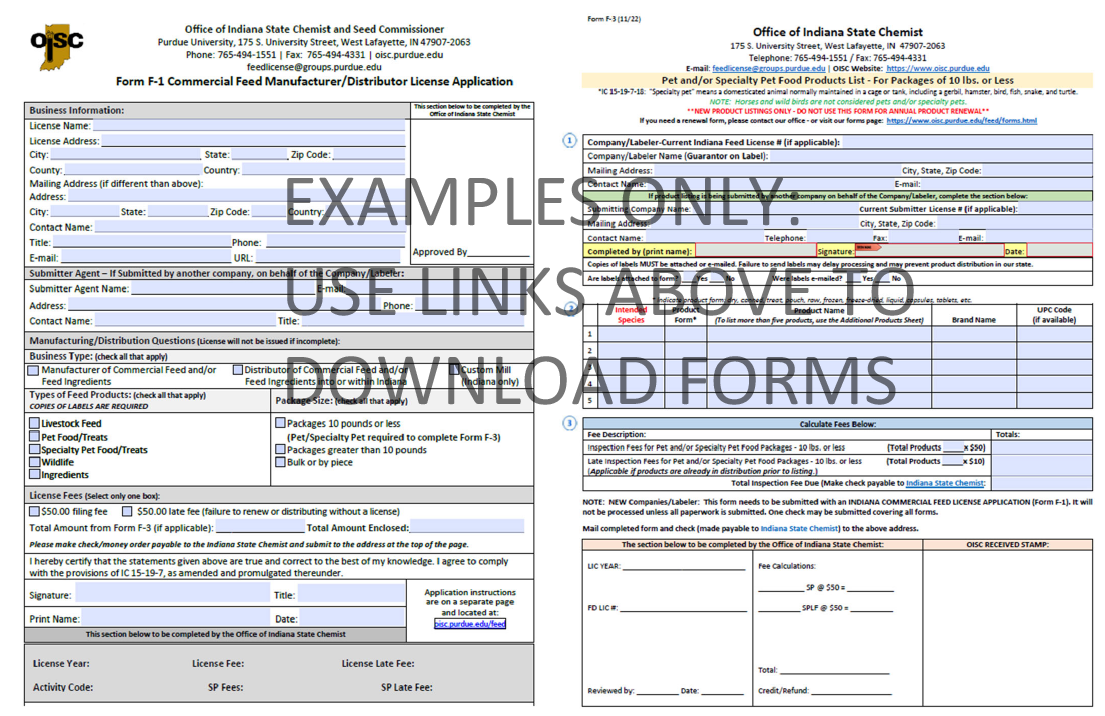 | |
Product Labeling:
All products must be properly labeled!
- All products must be properly labeled
- All labels must be reviewed by the Office of Indiana State Chemist
- All labels must meet criteria outlined in the Indiana Commercial Feed Law (IC 15‐19‐7)
- Labels must accompany the treat or food throughout distribution
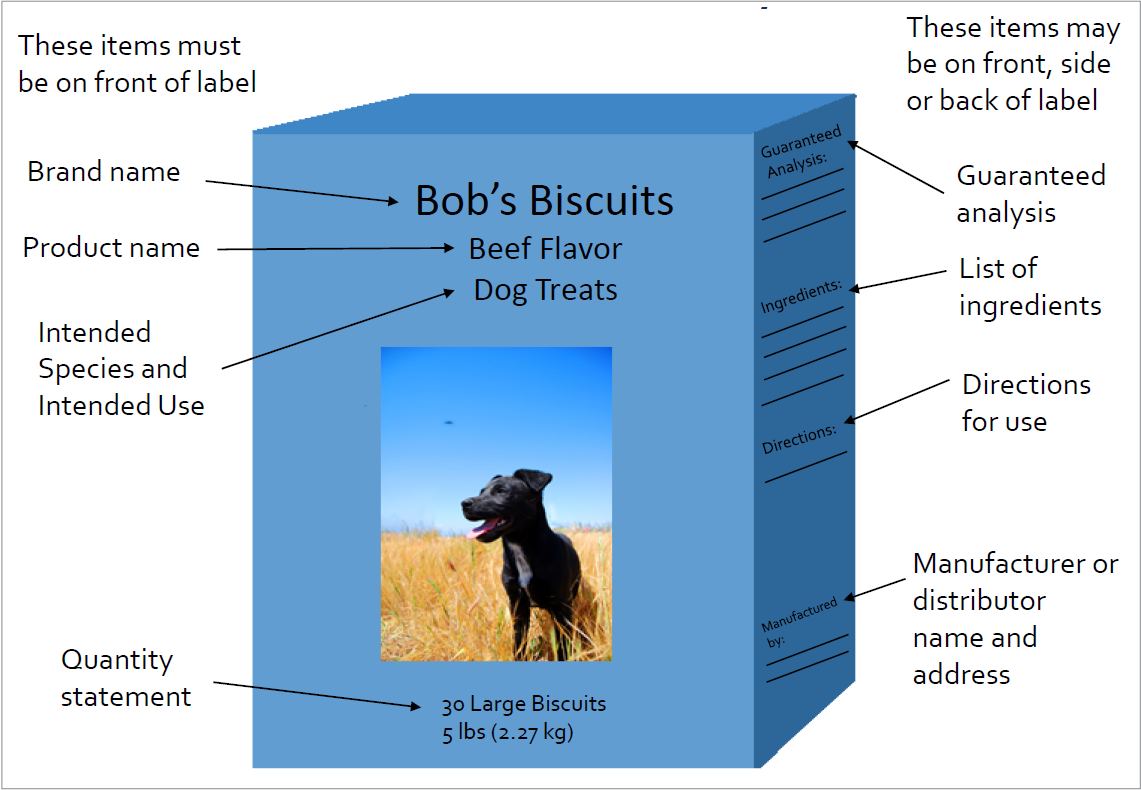
What must be on every label?
- Brand name (if any)
- Product name
- Intended species
- Intended use
- Guaranteed analysis
- Ingredient Statement
- Directions for use
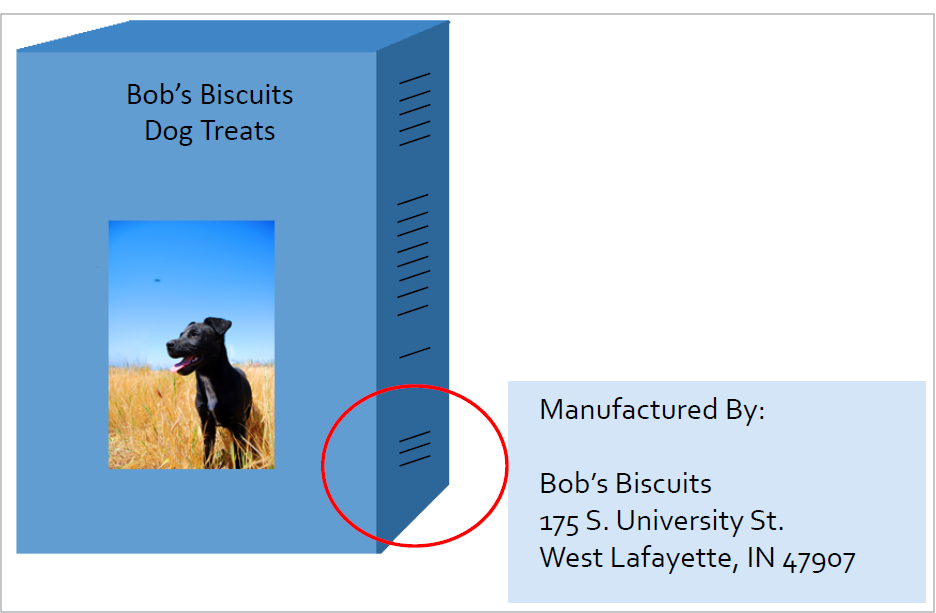
- Manufacturer or distributor name, city, state, zip code
- Quantity statement
Example of what must be on every label:
Product Name:
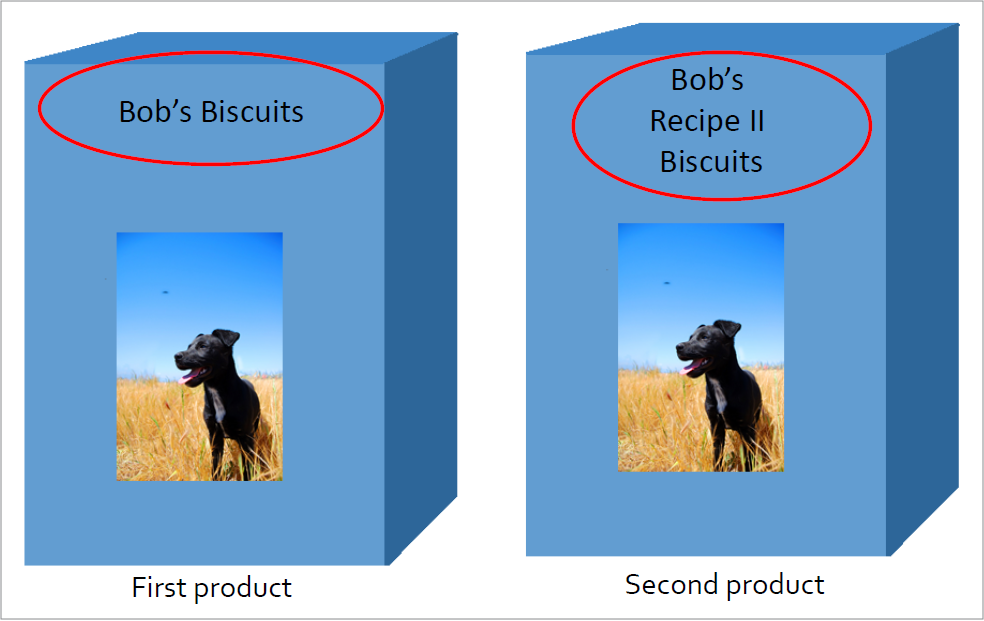
- Product must be identified with a name that conforms to the label and labeling
- If more than one product is produced, each product must be clearly and uniquely named
Examples of Product Name:
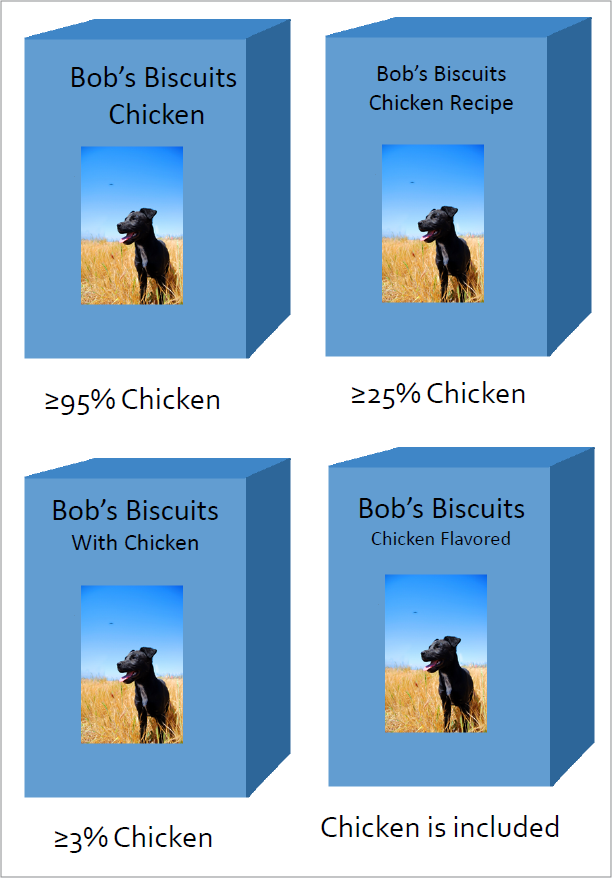
Product Naming Rules:
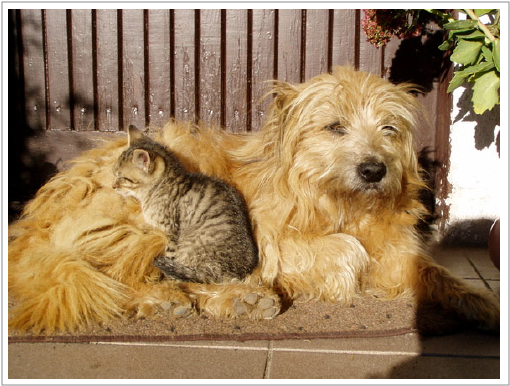
Intended Species:
- The intended species must be identified in words on the principal display panel (front of label)
- Dog, Cat, etc. - The intended species may be located in the product name, but this is not required
- A picture is not a good enough way to identify the intended species!
Intended Use:
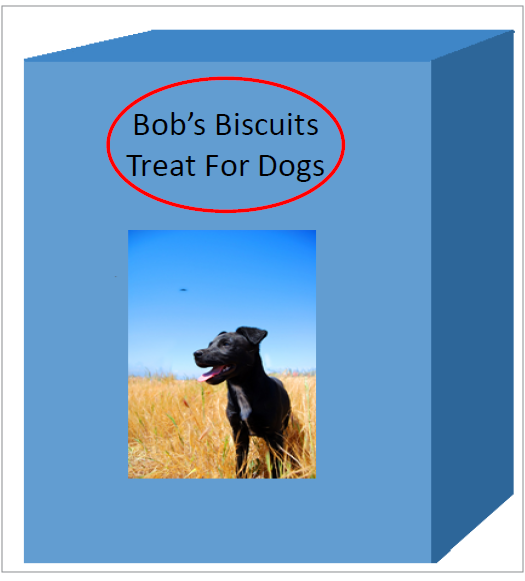
Treat or Snack must be on the front of the label.
OR
The following statement must be verbatim elsewhere on the label: “This product is intended for intermittent or supplemental feeding only”
Intended Use example:
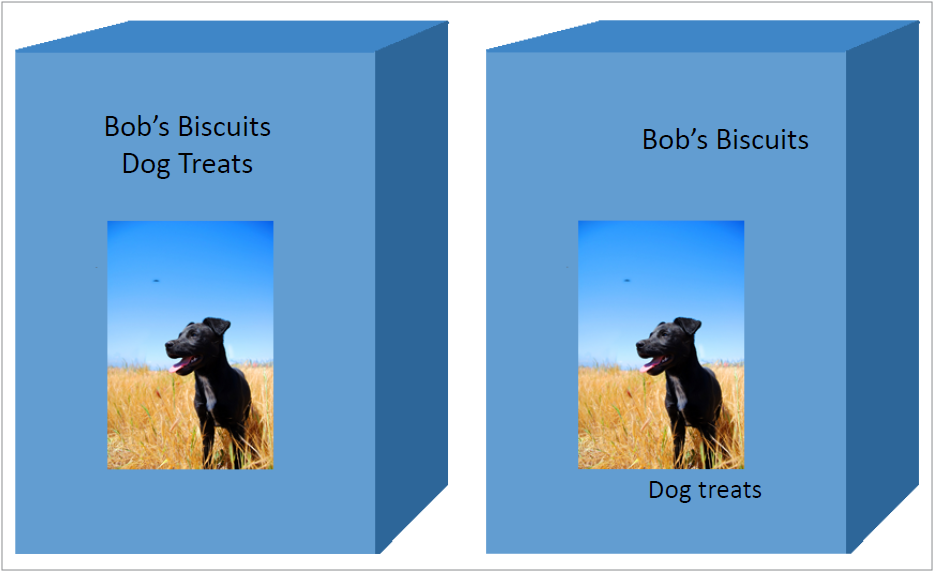
The intended use may be in the product name, but does not have to be.
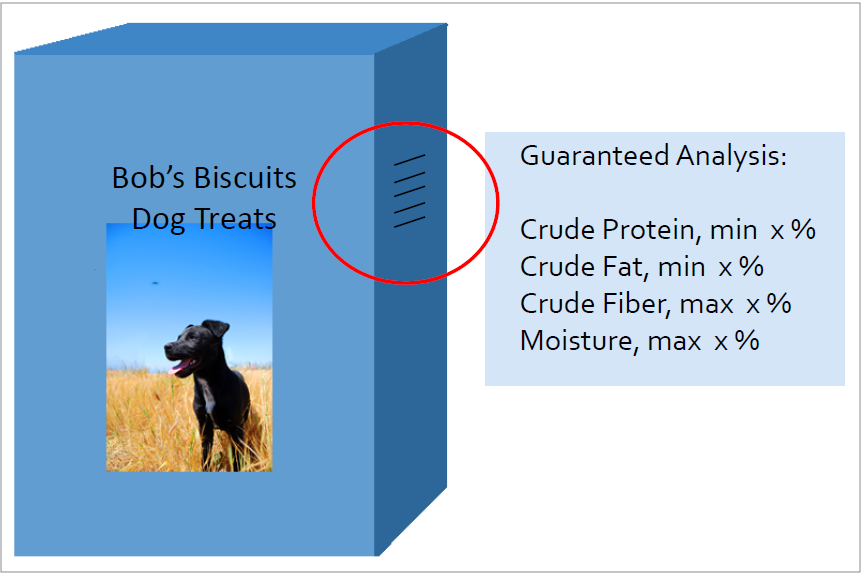
Guaranteed Analysis:
Crude Protein (Minimum %)
Crude Fat (Minimum %)
Crude Fiber (Maximum %)
Moisture (Maximum %)
- The guaranteed analysis must have the heading Guaranteed Analysis and be in the order given above.
- Voluntary guarantees may be claimed and listed as specified in the rules.
- If the label and/or labeling (including websites and social media) references other nutrients, then guarantees must be made for the referenced nutrients.
An analysis can be performed by any pet food laboratory. Food analysis laboratories may be found through an internet search. It is best to call around to get the best price.
OISC does not recommend any one laboratory.
Ingredient Statement:
- AAFCO-approved ingredient terms must be used, or
- Common or usual name of all ingredients used
- If one ingredient consists of multiple ingredients, each ingredient must be listed instead of the product name
- Example: Whole wheat crackers would be listed as: whole wheat flour, eggs, soybean oil, salt
For a treat made of whole wheat crackers and peanut butter:
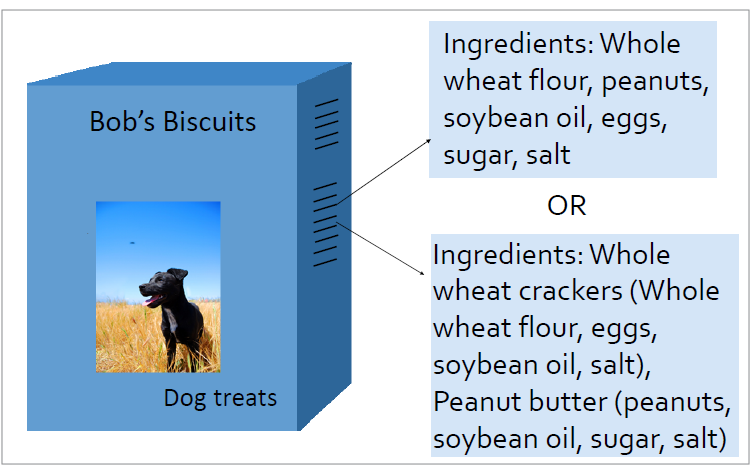
Ingredients must be listed by decreasing dominance by weight.
- All ingredients must be approved by either:
- The Food and Drug Association (FDA)
- Association of American Feed Control Officials (AAFCO) - If you have a concern or question, contact us prior to making the treat:
- Hours: Monday - Friday, 8 AM - 5 PM
- Telephone: 765-494-1611
| Safe for humans does not mean safe for pets! |
| Food | Not Safe | |
| Dogs | Cats | |
| Chocolate | X | X |
| Onion | X | X |
| Grapes/Raisins | X | X |
| Coffee | X | X |
| Garlic | X | X |
Directions for Use:
- Complete and Balanced Diet:
- Feeding directions must be stated for each life stage the label is claiming
- Must conform to AAFCO nutrient profile for intended species
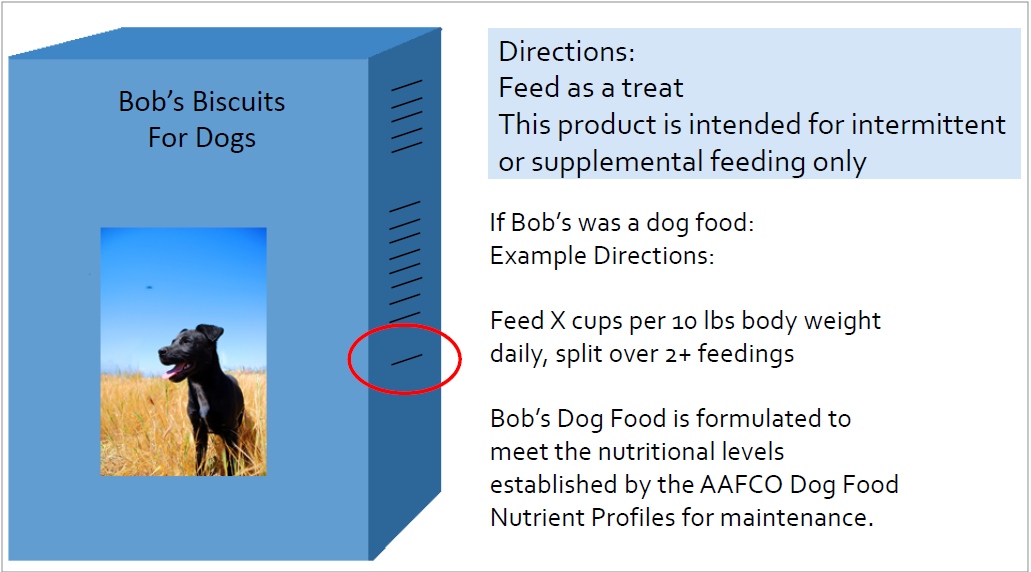
- Treats and Snacks:
- Must state “treat” or “snack” on principle display panel (front)
- OR state “This product is intended for intermittent or supplemental feeding only”
Example of Directions for Use:
Manufacturer Information:
- Party responsible - Name of business/company
- Must match name on your Indiana Commercial Feed License - Location ‐ City, state, and zip code of business
- A mailing address can be included, but is not required
| Websites or social media contacts are allowed, but the above information is still required. |
Manufacturer Information Example:
Quantity Statement:
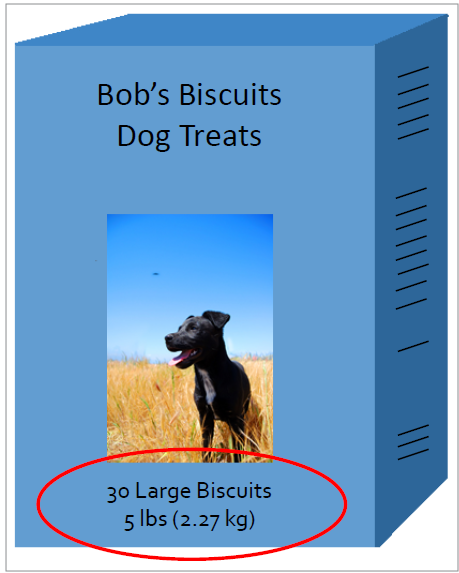
- May be in:
- Pounds
- Grams
- Ounces
- Other units of weight or volume
- By count - If using units of weight or volume, please state in both the US Standard and metric units of measurement
Example: X lb. (X g)
Example of Quantity Statement:
Distribution:
- If treats are distributed to the customer in packages greater than 10 lbs in weight or in bulk/by piece
- Company must file a quarterly tonnage report with our office - Minimum fee of $5.00 per calendar quarter or $0.40 a ton, whichever is greater
- Quarterly tonnage reports are mailed at the end of each calendar quarter to appropriate licensees
- If the tonnage report is delinquent, late penalty fees will be assessed, which is 10% of fees due or $50.00, whichever is greater
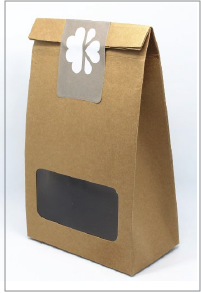
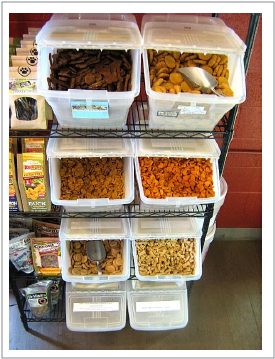
| Small Package | Tonnage |
- $50 License + $50/product | - $50 license + $5/quarter |
 |  |
Common Questions & Answers:
Q: I make three types of biscuits to sell at the local farmer’s market. Do I need to get labels printed for them and pay $200.00?
A: It depends on how you are selling them:
- IF you are pre‐packaging the treats in small bags (10 lbs or less), then yes
- IF you are selling them in bulk/by the unpackaged piece, then a complete label must be present for each treat, but you would be under our tonnage system.
Q: I take my treats to the farmer’s market in one pound bags to sell, what do I have to do?
A: You must label each bag and the $50 annual fee must be paid to our office for each product.
Q: I take my treats to the farmer’s market in a box, the customer may pick one, two, or as many treats as they want. What do I have to do?
A: You must:
- Label the container in which the treats are stored, making sure it is visible to the customer.
- File a quarterly tonnage report ($5.00 per calendar quarter)
Q: I have one recipe/formula for dog treats that I sell in 1 lb bags. I have bone shapes, cat shapes, mailman shapes and others. Do I owe $50.00 for each shape?
A: Not necessarily, the nutritional value and label is the same, regardless of the shape it comes in. However, if the product names are different, it is a different product.
Q: I make one recipe/formula, of dog treat. I put yogurt icing on top of some of them. Does this make the product different?
A: Yes, because you have changed the nutritional value of the treat by adding another ingredient. Therefore it is a new product and would have to be labeled accordingly. Another $50 annual product fee would be due.
Q: I have three recipes/formulas, and I want to combine them into a variety pack. How do I label them?
A: It depends on how they are packaged:
- If they are all mixed in a package together there must be a label with one guaranteed analysis and one ingredient list for the entire package as if the contents were ground up together.
- If they are in separate packages within the outer package, you must provide a label with a guaranteed analysis and ingredient list for each formula in the variety pack.
Q: I add beef bullion to my treats. Can I tell my customers that it is beef flavored?
A: Yes. If an ingredient imparts a flavor or distinction to the treat, that may be stated. (If it is an artificial flavor, it must be stated whenever the flavor is mentioned. It must be truthful and not misleading.)
Q: I want to make a dog treat but I have no idea how to figure the crude protein, crude fat, crude fiber or moisture. Will you do that?
A: No, but you may send samples to a laboratory and they can be analyzed for a fee. Food analysis labs can be found through an internet search. Some guarantees may be calculated if you know the ingredient values. You will want to call around to get the best price. The Office of Indiana State Chemist does not endorse any laboratories.
Q: Do you test treats for regulatory purposes?
A: Our office collects random samples of all types of animal feeds and analyzes them for nutrient content and potential hazards. The Indiana Commercial Feed Law empowers our inspectors to collect samples offered for retail distribution during normal business hours.
Q: I bake treats at home. Do you inspect my kitchen?
A: Not under normal circumstances. The only time we would perform such an inspection is if we received a complaint from a customer related to the treat. We investigate consumer complaints if an animal has become ill or died and a veterinarian suspects the food.
Q: I want to call my treats all natural ‐ may I?
A: You may if it’s true. Most foods will not be all natural because they contain minerals, vitamins, and preservatives. So the statement must be qualified.
Q: May I put on my labels that my treats are human grade?
A: In order to put this claim on the label and/or labeling (including websites and social media) you must provide the following information to the Office of Indiana State Chemist:
- Documentation to substantiate that all ingredients and the resulting product are processed, handled, stored, and transported in a manner in compliance with 21 CFR 507
- Evidence that the manufacturing facility is licensed to produce human food
- Supplier specification sheets for each ingredient
- Letters of guarantee from each supplier that the ingredients are human food grade
Q: Can I sell raw milk in Indiana?
A: Yes, but only for animal consumption. In Indiana, the sale of raw milk for human consumption is prohibited. The same requirements as selling pet food and treats, except the label must also contain "Not for Human Consumption:" prominently on the front of the label. Visit our "Selling Raw Milk" page for more information, including what must be included on raw milk labels.