

What is raw milk?
IC 15-19-7-17.5
"Raw milk"
Sec. 17.5. As used in this chapter "raw milk" means any milk or milk product, including butter, yogurt, cottage cheese, and cheese, from any species other than humans, that has not been pasteurized according to processes recognized by the United States Food and Drug Administration. The term does not include United States Department of Agriculture approved veterinary biologics.
What do I have to do to sell raw milk in Indiana?
- Please note: Raw milk cannot be sold for human consumption in Indiana. All raw milk products must follow all pet food labeling requirements.
- Obtain a Commercial Feed License before distribution.
- The Indiana Commercial Feed License is $50 annually (January 1- December 31)
- Everyone must be licensed regardless of company size or amount distributed.
Containers 10 lbs. or less:
- For containers 10 lbs. or less, a Pet Food Listing Form must also be included. It is $50 per product annually.
- Mail forms and a check for the appropriate amount to the Office of Indiana State Chemist.
Containers greater than 10 lbs.:
- For containers greater than 10 lbs:
- If the products are distributed to the customer in containers weighing greater than 10 lbs - the company must file quarterly tonnage reports with our office.
- A Minimum fee of $5.00 per quarter or $0.40 per ton, whichever is greater.
- Quarterly tonnage reports are mailed at the end of each quarter to appropriate licensees.
- There is a late fee of $50 if the tonnage report is returned late.
Product Labeling:
IC 15-19-7-40 Prohibited acts
(7) The distribution of raw milk for use as a commercial feed for any species if the raw milk is not prominently labeled "Not for Human Consumption".
All products must be properly labeled.
- All labels must be review by the Office of Indiana State Chemist
- All labels must meet criteria outlined in the Indiana Commercial Feed Law and Pet Food Rules IC 15-19-7
- Labels must accompany the raw milk products throughout distribution and use.
What must be on every label?
- Brand name (if any) – on the front
- Product name – on the front
- Intended species in words – on the front
- Intended use
- Not for Human Consumption - prominently on the front
- Guaranteed analysis
- Ingredient statement
- Manufacturer or distributor information
- Quantity statement – on the front
Product Name:
- Must be on the front of the label
- Product must be identified with a name that conforms to the label and labeling
- If more than one product is produced, each product must be clearly and uniquely named:
- Example:
- Raw Cow Milk
- Raw Goat Milk
- Raw Goat Cheese
- Raw Cow Butter
Intended Species:
- The intended species must be identified in words on the front of the label (example: Dog, Cat, etc.)
- The intended species may be located in the product name, but this is not required (examples: Treat for Dogs and Cats, Dog and Cat Supplement, Raw Cow Milk for Dogs, Supplement for Dogs and Cats)
- A picture alone is not a sufficient way to identify the intended species!
Intended Use:
- Labels must state “treat”, “snack”, or “supplement” on the front of the label
- OR must have the following verbatim statement somewhere on the label: “This product is intended for intermittent or supplemental feeding only”
Guaranteed Analysis:
Crude Protein (Minimum %)
Crude Fat (Minimum %)
Crude Fiber (Maximum %)
Moisture (Maximum %)
- The guaranteed analysis must have the heading Guaranteed Analysis and be in the order given above.
- Voluntary guarantees may be listed as specified in the rules.
- If the label or labeling claims other nutrients, then a guarantee must be made for that claim. Example: “Contains Vitamin D” – requires a vitamin D guarantee added to the guaranteed analysis.
- The best way to get the guaranteed analysis is by sending a sample to a lab. You can search “food analysis labs” online to find options. NOTE: It is always best to call around to get the best price.
- Using the “as received” values. The minimum values must be set below the laboratory result. The maximum values must be set above the laboratory result. Please do not put 0% guarantees or 100% guarantees on the label.
- NOTE: OISC does not endorse any laboratories or recommend one laboratory over another.
Ingredient Statement:
Examples:
Ingredients: Raw (Species) Milk
Ingredients: Unpasteurized (Species) Milk
- If it contains other ingredients:
- AAFCO acceptable ingredient terms must be used, or
- Common or usual name of all ingredients used
- If one ingredient consists of multiple ingredients, each ingredient must be listed instead of the product name, or in parentheses after the ingredient.
- Unless the ingredient has a standard of identity
Ingredient Statement:
Safe for humans does NOT mean safe for pets!
| Food | Not Safe | |
| Dogs | Cats | |
| Chocolate | X | X |
| Onion | X | X |
| Grapes/Raisins | X | X |
| Coffee | X | X |
| Garlic | X | X |
This is not an all-inclusive list. Please contact us if you have any questions.
Manufacturer Information:
- Party responsible – Name of business/company
- Must match the name on the Indiana Commercial Feed License - Location - City, state, and zip code of business
- A street address can be included
| Websites or social media contacts are allowed, but the above information is still required on the label. |
Quantity Statement:
- Must be on the bottom third of the front of the label
- Must be given in both the English and metric units
Examples:
1 gal (3.79L)
1 quart (946 mL)
Label Examples:
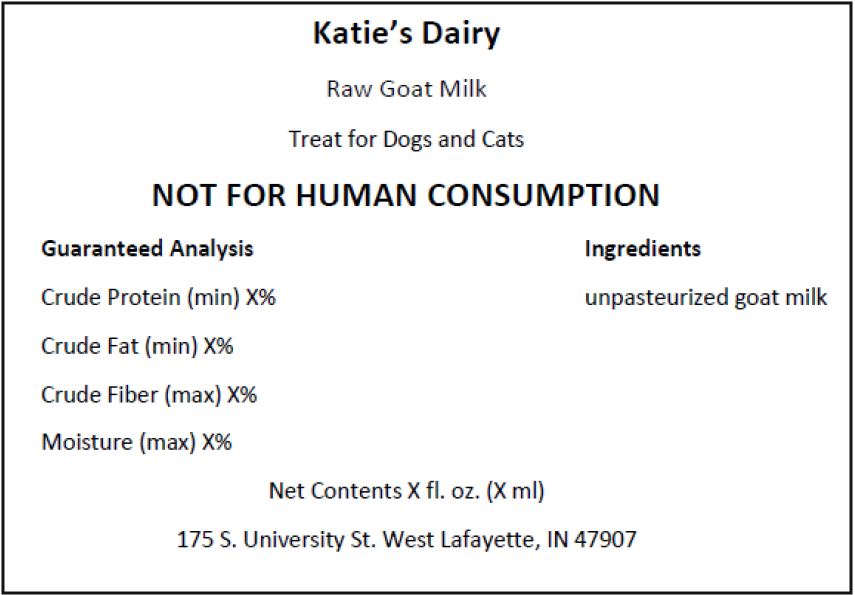
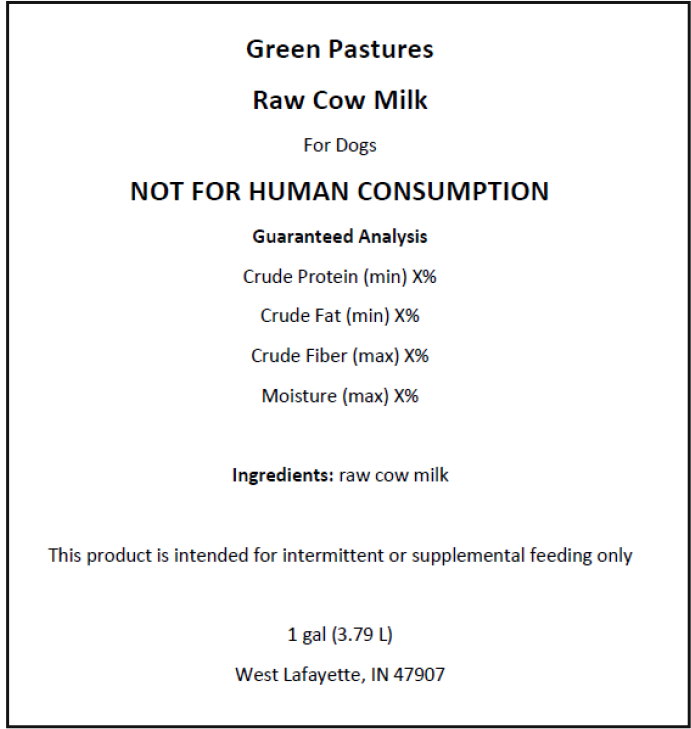
Product Labeling - Labeling includes websites, social media, and all e-commerce sites
All labeling must prominently contain the statement “Not For Human Consumption” for all Raw Milk products
IC 15-19-7-8
"Label"
Sec. 8. As used in this chapter, "label" means a display of written, printed, or graphic matter upon or affixed to the container in which a commercial feed is distributed or on the invoice or delivery slip with which a commercial feed is distributed.
IC 15-19-7-9
"Labeling"
Sec. 9. As used in this chapter, "labeling" means all labels and other written, printed, or graphic matter:
(1) upon a commercial feed or its containers or wrappers; or
(2) accompanying a commercial feed.
Claims
All labeling rules and regulations regarding claims also apply for websites, social media, and all e-commerce sites.
- All claims must be truthful and not misleading.
- Animal food cannot indicate that the product is intended to diagnosis, cure, mitigate, treat, or prevent disease, illness, or condition.
- Nutrient claims made in labeling require guarantees
- Claims about antibiotics and/or hormones, must be stated in a way to indicate the animals used were raised without the use of antibiotics or added hormones.
- Stating antibiotic free or hormone free is not allowed.
Common Questions & Answers:
Q: Do you test products for regulatory purposes?
A: Yes, our office collects 3,000+ animal feeds a year and analyzes them for nutrient content and potential hazards. The Indiana Commercial Feed Law empowers our inspectors to collect samples offered for retail distribution during normal business hours.
Q: Do you inspect our farm?
A: We have the authority to inspect your farm during normal business hours under IC 15-19-7-34.5 and IC 15-19-7-35. These inspections may be announced or unannounced.
We also investigate consumer complaints if an animal has become ill or died and a veterinarian suspects the product.