

When purchasing seed, it is difficult to determine the difference between the lots of seed. The seed tag, label, or placard informs purchasers about the content of the lot, the quality and the genetic information of the labeled seed lot. The seed label allows the consumer to make choices that are more informed, and in doing so allows the opportunity to purchase higher quality seed. All seed sold should follow the Federal Seed Law. The Federal Seed Act (FSA) was passed in 1939. It requires accurate labeling with purity and germination standards for seeds in commerce. The act was put into place to protect both distributors and purchasers of seeds. The FSA operates at both federal and state levels. Within each state there is a state seed law and state regulations. In Indiana, the State Seed Rule is modeled after the Recommended Uniform State Seed Law. This allows for uniformity of the laws and regulations between the states to make competition fairer4.
In Indiana, the Indiana State Seed Laboratory in the Office of Indiana State Chemist (OISC) regulates the FSA. OISC regulates seed by checking the quality and that the seed label matches the seed lot. An inspector collects random seed samples to submit to the State Seed Lab for testing. Certified seed analysts check the purity, germination and noxious weed content of the seed. The Indiana State Seed Laboratory follows the guidelines set by the Association of Seed Analysts (AOSA).
Here is a brief overview of what components a basic seed tag should have for different classes of seed. The green check indicates a requirement; the red X means that component is not necessary.
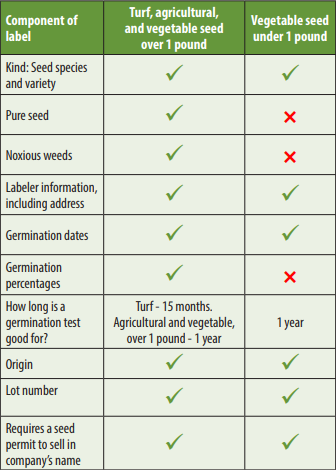
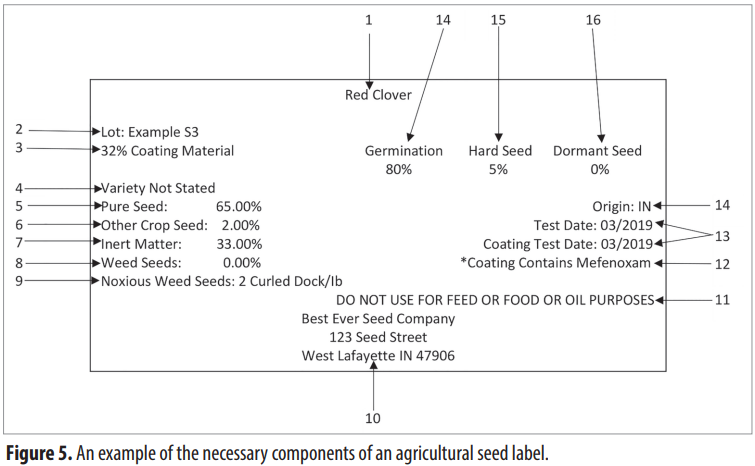
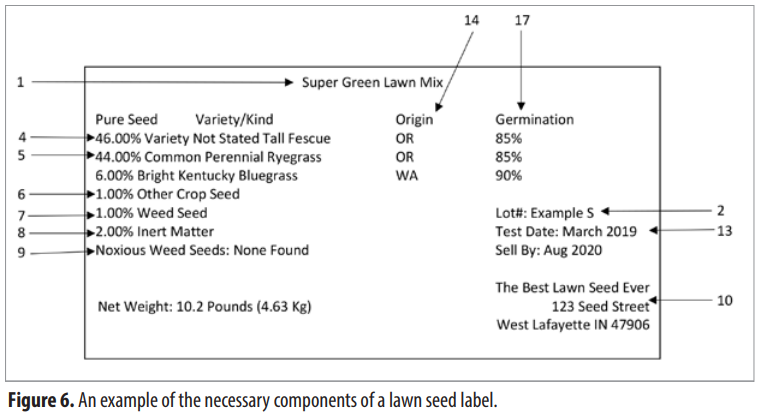
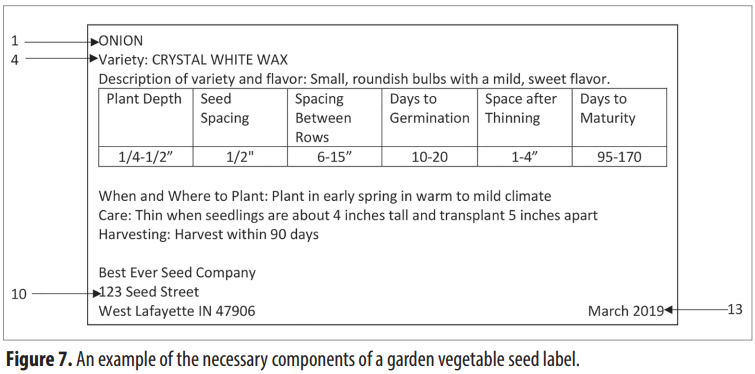
The following is an in-depth description of seed label components, with reference to the seed label examples. This list follows the Indiana State Seed Law.
1: Product Name
The name often includes the kind and brand, and sometimes the variety. There are often descriptive terms used to help the consumer make decisions on which type of seed to get. For example, in a lawn mix the name might include “sun” or “shade.” If the seed is a mixture it must be stated, and most companies put it here.
2: Lot Number
All seed sold must have a lot number. This number can be determined by the company. Some companies choose unique numbers for each lot; some use the same number for multiple lots.
3: Coating Material
When the seed is coated or pelleted it must be claimed. The percentage can be listed separately or in the inert, usually with a disclaimer saying the percentage of coating. The type of coating has to be listed on the package of seed.
4: Variety/ Kind
The kind of seed must be stated on the seed tag. According to the USDA, the kind should be listed separately from the descriptive terms. Example: Soft Red Winter Wheat is a description of the kind, with Wheat being the kind. The variety has to be stated, or “variety not stated” can be used. The abbreviation “VNS” is not allowed in every state. For corn and soybeans, the hybrid or brand can be used in place of the variety10.
5: Pure Seed
All agricultural and turf seed must have pure seed components. Pure seed components include the pure seed, other crop seeds, weed seeds and coating material. All of the seed components must add up to 100%. These pure seed components are calculated by percentage of weight. According to AOSA, pure seed is “any seed with at least half of the embryo still attached.” For refuge corn (95/5) it is recommended to add a separate box on the tag that includes the pure seed components in addition to the blend components.
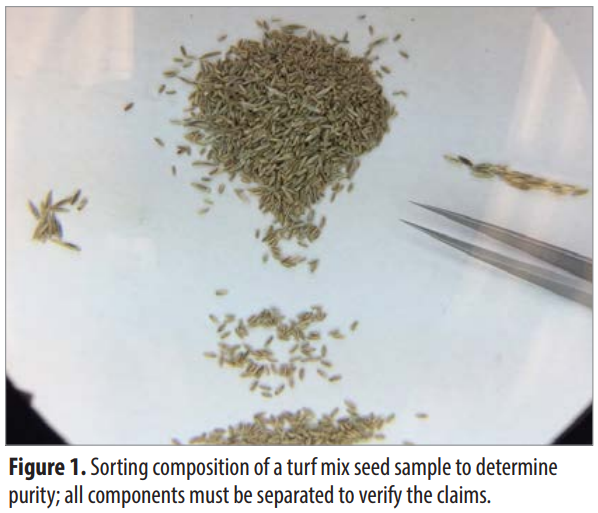
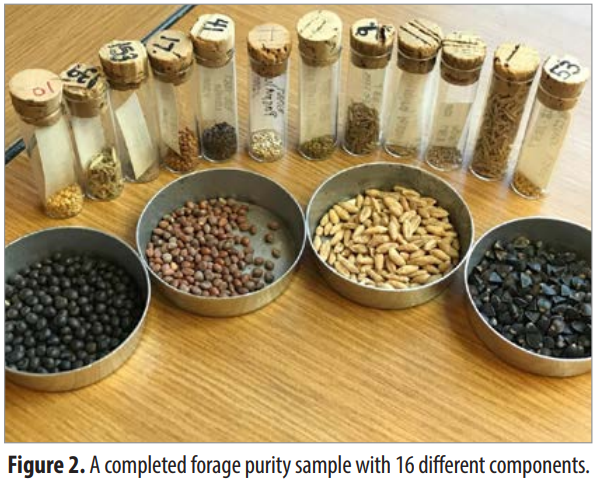
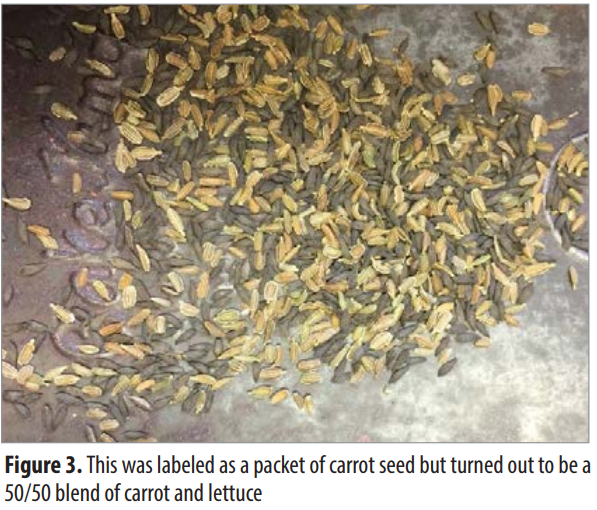
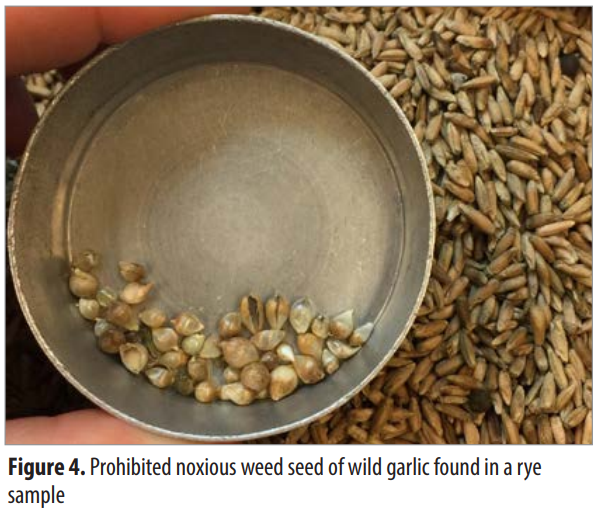
The pure seed information is vital to the seed label because it informs the consumer about what is in the lot of seed, and allows the consumer to choose between different varieties and seed kinds. Figures 1 and 2 show the separation of the lot into its individual components. When the Indiana State Seed Laboratory checks the seed, it separates a representation of the lot of seed into individual components and compares the pure seed component percentages to what has been claimed on the label. The lot in figure 3 shows why accurate labeling information is important. That lot of seed claimed to be only carrots but was a 50/50 carrot and lettuce blend.
6: Other Crop Seed
There is a tolerance for other seeds and debris being in a seed lot. A 100% pure seed sample is unlikely, so there needs to be a claim for other crop seeds. Other agricultural or turf seeds can be claimed by weight percentage found. A seed component that makes up greater than 5% of the sample must be claimed as a component on the label, and the term “mixture” must be added10.
7: Inert Matter
Inert is anything in the lot that is not a seed, or seeds that will not grow, such as ergotized seed. Every seed lot will contain inert matter and should be added by percentage of weight10.
8: Weed Seeds
Weed seeds, just like “other crop seeds,” must be claimed. There is a tolerance to the number of weeds in a sample. No sample should be sold with more than 2.5% weed seed10. This percentage is also calculated by weight.
9: Noxious Weed Seeds
Noxious weeds are a state-by-state list of economically hazardous weeds. There are two categories: restricted and prohibited. Any restricted weeds must be claimed on the label, along with how many seeds can be found per pound of seed. No prohibited seeds can be claimed because they should not be sold in the states where they are prohibited. If no noxious weeds are found, then the statement “none found” can be used.
10: Labeler
The labeler is the company that provides the seed. The labeler and labeler’s address must be listed on every seed tag.
11: Disclaimer
If the seed is treated, the statement “Do not use for food, feed or oil purposes” must be used10.
12: Seed Treatments/ Microorganisms
If the seed is treated it must be dyed a color that makes it distinguishable from other seed. The tag must include the name of the treatment used on the seed, and an additional tag can be used stating the active ingredients and the hazards associated with the chemicals. If the seed has a microorganism, those too must be claimed with the title of the inoculant.
13: Germination Dates
A test date for the germination test must be included on the label – and, if applicable, the inoculant test date. This is sometimes written as “sell by”9. Agricultural and
vegetable seeds are good for a year, and turf seed test dates can last up to 15 months.
14: Origin
The origin of where the seed was grown must be put on the label for each seed component. Vegetable packets under a pound do not have to list the origin. If the origin is unknown, then it must be stated as such9.
15, 16, 17: Germination
The germination rate for the seed must be included on the label for turf or agricultural seed. If the seed contains hard seeds, a claim must be made. Dormant seed can be listed but is not required. Most regulatory labs do not look at seed dormancy. If hard seed and dormancy are listed on the label, the percentages must be listed separately. Some companies will include a total germination. Vegetable seeds under 1 pound do not have to claim germination percentages because there is a federal list of standard germination percentages9.
Each seed tag or label can have a different layout but must contain the same basic components. A seed tag or label should be found on any seed sold, advertised, or transported with intent to plant in the United States9. Different states have different seed laws, so labels will require different information based on the state they are sold in. For example, some states allow brand names on labels while others do not. Even with differences the seed label tells purchasers what type of seed they are buying, and the variety and the quality of seed with purity and germination information. If there are any concerns or questions about a seed label, contact your state’s seed laboratory. A list of state seed control officials
can be found at https://www.seedcontrol.org/membership_directory.html.
Sources:
- Kaiser, Jerry. Reading Seed Packaging Labels (Seed Tags.) Agronomy Technical Note. February 2010.
- A Simplified Guide Understanding Seed Labels. NRCS Plant Materials Program. August 2007.
- AASCO www.seedcontrol.org/
- Agricultural Products. April 3, 2019. IC 15-15
- American Seed Trade Association, the State. www.betterseed.org/the-issues/state/
- AOSA Seed Testing Definitions Section III Purity Analysis. www.analyzeseeds.com/seed-testing-definitions
- Federal Seed Act. USDA. www.ams.usda.gov/rules-regulations/fsa
- RUSSL. AASCO. https://www.seedcontrol.org/russl.html
- Title 360 Indiana State Seed Commissioner. Article 1. Standards for Seed and Seed Labeling.